
This tracks brand visibility in ChatGPT answers. It is not an AI-written text detector.
The page explains how to track ChatGPT visibility. The live check below uses GPT with web search; it does not query the consumer ChatGPT app. Every usable result shows the prompt, AI family, time, raw answer, and returned citation links so you can inspect the evidence yourself.
Live evidence check
Check whether your brand appears in AI answers
This tracks brand visibility in ChatGPT answers. It is not an AI-written text detector.
Live check: GPT with web search. This is an API observation, not the consumer ChatGPT app.
What a ChatGPT rank tracker can and cannot measure
ChatGPT does not expose a stable numbered search ranking. A defensible tracker records answer-level observations under named conditions.
| It can record | It cannot prove |
|---|---|
| Whether the exact brand or domain appears in one returned answer | A permanent “position” across all ChatGPT users |
| Whether a structured source link points to the monitored domain | That a citation will create traffic or sales |
| The prompt, provider, model, search mode, time, and raw response | Why the model chose or omitted a source |
| Changes across repeated runs using the same prompt set | That a site change caused a later model change |
A successful answer without the brand is not mentioned. A provider failure or unreadable response is unavailable, not a negative observation. Keeping those states separate prevents outages from lowering the visibility result.
Exact methodology
The mini tool follows this sequence:
- You provide one brand, one public domain, and three to five unique prompts.
- Each prompt is sent once to the documented provider and model with web search enabled.
- The tool stores the prompt, provider, model, search setting, timestamp, raw answer, structured citation links, and evaluation version.
- Brand detection uses the complete brand phrase or domain, not a loose partial match.
- Domain citation detection uses only structured links returned by the provider.
- The summary denominator includes only usable answers. Provider and parsing failures remain visible but are excluded.
One run is a snapshot. For a more stable comparison, reuse the same prompt set, keep the market and language consistent, and repeat observations on a planned cadence. Read the full SkillAEO measurement methodology before comparing results from different engines.
Prompt categories
Use prompts that represent real decisions rather than repeatedly naming your own brand.
| Category | Example prompt | What it tests |
|---|---|---|
| Discovery | “What tools help SaaS teams monitor AI visibility?” | Whether the brand enters an unaided consideration set |
| Comparison | “Compare AI visibility platforms for an agency.” | Which alternatives appear and how they are described |
| Use case | “How can a marketing team audit citations in AI answers?” | Whether the product is associated with a specific job |
| Problem | “How do I find why my company is missing from AI answers?” | Whether the brand appears around a pain point |
| Branded verification | “What is SkillAEO and what does it do?” | Whether the model describes the known brand accurately |
Keep branded prompts separate from discovery prompts. A model finding a brand after the prompt names it is not the same signal as an unaided mention.
Why results fluctuate
Two honest runs can differ. Model versions change, web indexes refresh, search tools retrieve different pages, source availability changes, and small wording differences alter the task. Account state, location, language, product surface, and sampling settings can also matter.
That is why each observation needs its conditions. Compare like with like, retain the raw answers, and treat a single change as a lead for investigation rather than proof of improvement.
Manual tracking template
Use this compact table when you test the consumer ChatGPT app manually. Copy one row per prompt and keep the complete answer in a linked note or export.
| Field | Record |
|---|---|
| Observation time | ISO date and time, including timezone |
| Product surface | Consumer ChatGPT, API, or another named product |
| Account and mode | Signed in/out, search enabled/disabled, visible model label |
| Exact prompt | The full text, unchanged between comparable runs |
| Brand mentioned | Yes / No / Unavailable |
| Owned domain cited | Yes / No / Unavailable |
| Source links | Exact URLs shown with the answer |
| Raw answer | Complete response, not a summary |
| Notes | Material inaccuracies, competitors, and changed conditions |
Do not combine manual consumer-ChatGPT observations with API observations unless the product surface remains visible in your dataset.
Product comparison
The table below is a purchase-research snapshot, not a ranking. SkillAEO values come from the site's current plan catalog; competitor values link to first-party pages and should be rechecked before buying.
| Product | Public entry price | Prompt / model snapshot | Cadence | First-party source |
|---|---|---|---|---|
| SkillAEO | $0 Free plan | This mini tool: 3–5 prompts, one documented model. Free full audit: 8 prompts, 1 model. | On demand | Current pricing |
| Peec AI | $95/month Starter | 50 prompts, 3 chosen models, 1 project | Daily | Vendor page |
| OtterlyAI | Starts at $29/month | 15 prompts on the current Lite plan | Daily | Vendor page |
| Scrunch | $300 month-to-month; $250/month billed annually | 350 custom prompts plus 1,000 industry prompts | Plan-dependent monitoring | Vendor page |
Real example with raw evidence
On 2026-08-18, a validation run submitted three prompts for SkillAEO / skillaeo.com to openai/gpt-4o through OpenRouter with web search requested. OpenRouter returned 403: This model is not available in your region for each prompt. The run therefore recorded:
| Evidence field | Recorded value |
|---|---|
| Product surface | API |
| Provider / model | OpenRouter / openai/gpt-4o |
| Valid answers | 0 of 3 |
| Brand mentioned | Unavailable, not “No” |
| Raw answer | Empty because no model answer was returned |
| Citation links | None returned |
This failed run is useful evidence: it verifies that provider availability is kept separate from brand absence. It is not evidence about whether ChatGPT would mention the brand.
Illustrative example: for the browser and layout check, we use a controlled successful fixture with the raw answer “SkillAEO is an AI visibility auditing platform” and a structured link to https://skillaeo.com/methodology. The screenshot below is explicitly illustrative; those values are not presented as a live model observation.
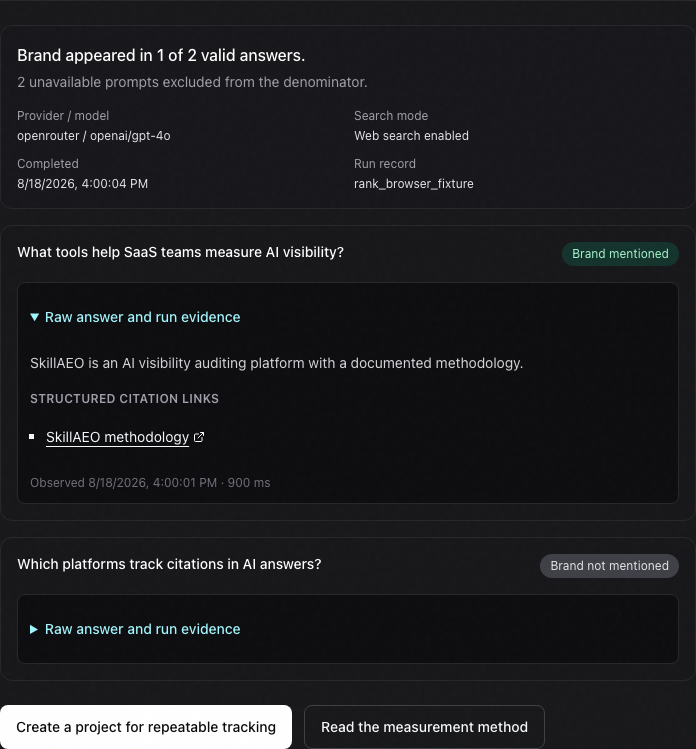
Illustrative local capture; values are not live evidence.
Frequently Asked Questions
Is this an AI-written text detector?
No. It observes whether a brand or domain appears in answers to a defined prompt set.
Does the mini tool query my ChatGPT account?
No. It uses the provider and API model shown beside the result. Consumer ChatGPT can behave differently, so record manual tests separately.
Can I track a single ChatGPT rank?
Not defensibly. Record mention, citation, accuracy, and the full response for each prompt instead of inventing a universal numbered position.
Why are failed prompts excluded from the denominator?
A provider outage or unreadable response says nothing about brand visibility. Counting it as “not mentioned” would create a false negative.
How often should I repeat the prompts?
Choose a cadence based on how quickly your site, market, and decisions change. Keep the prompt set and conditions stable enough for the comparison you intend to make.
What should I do after the free check?
Create a project for multi-engine audits and repeatable history, then use the raw evidence to decide what actually needs investigation. No run guarantees a future mention, citation, traffic, or ranking outcome.